

How To Start A Flue Drawing
Chimney and Flue Pattern
How practise we go the smoke to go upwardly a chimney? A properly congenital chimney will naturally "draw" the rising hot air roaring up the chimney which stops smoke coming into the room and as a result the fire burns better by sucking air and oxygen through the fire.
To make the chimney draw it has to be designed properly with a constriction, a narrowing of the flue. A chimney without a constriction volition not draw but can hands be modified to get information technology working correctly. The scientific principle is known as the venturi effect.
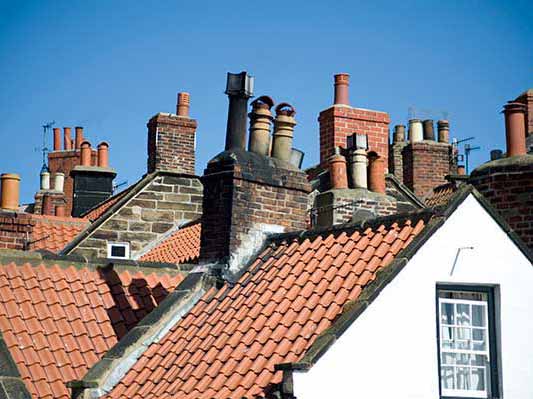
Getting a flue or chimney to "draw"
I met a man who had a fireplace built in his new business firm and was told by his builder that he would need an electric fan in the chimney to draw the smoke out. A fan? That doesn't sound right does it, chimneys accept been in use for thousands of years and they didn't take electrical fans back in mediaeval times at present did they?
There is in fact an ancient fine art to getting a flue to draw. There used to be skilled artisans who would travel effectually the countryside setting people'south flues and so that fires would burn properly, the smoke would get up the chimney and not come out into the room.
These days of class the science is well understood.
The Venturi Effect
The secret to getting a flue to draw is to take a constriction in the chimney. This work on the venturi principle and is named subsequently an Italian physicist Giovanni Batista Venturi (1746 - 1822). Air moving up the chimney has to compress to get through the gap of the constriction, once through the chimney opens out and the pressure level in the rising air falls causing a partial vaccum. This area of lower pressure sucks air into information technology through the gap. The air passing upwards through the constriction and on up the chimney speeds up and the flue starts to draw, pulling air up the chimney.
This venturi concept is used in Carburettors to suck air and petrol into a car engine and drawing air in to mix with the gas in the burners of your gas stove. Have you ever noticed that power station cooling towers are narrower in the middle? The Venturi principle is besides the principle that makes yacht sails and air craft wings piece of work, the curve in the upper surface of an aircraft wing makes air travel over the fly faster than under the wing causing lower pressure on the upper surface which sucks the aeroplane upward. The ability to lift the weight of an aircraft demonstrates the power that the venturi principle can generate.
And then to a higher place a fireplace we put a chimney with a constriction to a higher place the fire. Getting the constriction simply right used to be a real artform. These days it is a science and we encounter the venturi principle used in many ways such as pulling petrol into your car engine using a venturi in the blueprint of a carburretor and drawing air in to mix with the gas in the burners of your gas stove. Have y'all ever noticed that power station cooling towers are narrower in the middle?
At present I am sure y'all are reading this and thinking what on world is the relevance of all this. Well I have come up across people that desire a fire place however they observe it well-nigh impossible to find a person with the cognition to build a flue that works correctly. People don't understand and hence the builder who thought that y'all need to install a fan.
Setting a flue
If you have a chimney that doesn't draw properly or y'all wish to build ane you demand to build the flue with a narrow role above the fireplace at the bottom of the chimney. It is a good idea to make information technology in such a fashion that yous can easily modify information technology later if y'all need to just in instance yous take not got the correct amount of constriction.
Outset off with a constriction that is one-half or 2 thirds the size of the balance of the chimney. Light the fire and try information technology and adjust it as necessary.
You lot demand to know that:
- If the constriction is non narrow enough the chimney will not draw well.
- If the constriction is besides narrow the chimney volition draw as well well and the wood or coal y'all are called-for will burn away far likewise speedily.
- If the constriction is fifty-fifty narrower it will deadening downwardly the amount of hot air that can get up the chimney and will slow the fire down.
You lot need to notice the sugariness spot with a practiced compromise or you could install a "Damper."
Dampers are used to command fires
In the days when most houses had fireplaces and chimneys the chimney would unremarkably have a "damper" installed to change the size of the constriction in the flue and in this mode control the fire. A damper was either a piece of bandage iron (cast fe withstands the heat better than steel) that slid across the flue or turned like a butterfly valve in the flue to restrict the catamenia. Equally y'all increased the constriction y'all could increase the amount of draw and get the fire roaring - very useful when first lighting the fire or apace heating the room up. Just as you increase the constriction farther you would attain a point where further constriction would "dampen" the fire slowing down the rate of flow up the flue and this would save fuel, information technology would make the fire burn slower and use less coal or wood. This is how they managed to proceed a fire going all night.
Venturi flues tin can proceed your house cool.
More than importantly this same venturi principle can also exist used to ventilate roof spaces and keep houses libation.
In Queensland, Australia the old firm builders used to install a small vertical chimney with a decorative cowl on the top in the centre of the highest ridge of a roof. The vents were well-nigh 300mms in diameter and mayhap 800 mms long with a smaller diameter of pipe in the middle to form a constriction.
The roof space under a corrugated iron roof can get very hot and has very few gaps to allow ventilation so the old house builders came up with the idea of these vertical roof vents and found they were very effective. The vent would draw hot air out of the roof space drawing libation air in under the eaves along the bottom edge of the roof. The constant air flow through the roof space would take away the rut and keep the house cool.
These days many houses have tiled roofs and roof space ventilation is non an effect equally there are usually lots of gaps betwixt the tiles which permit the air to circulate freely. Notwithstanding if your roof is fairly well sealed and has a lining nether the tiles or if it is corrugated iron, colourbond, asbestos or, as I saw recently, copper sheet, an effective roof vent may exist a sensible option.
The thing about using a venturi is that this natural phenomenon can exist used to create air movement even on the stillest of days. It is very unproblematic, very low toll and with no moving parts to become incorrect.
Information technology is early on days yet but as initiatives to gainsay global warming combined with the high cost of energy beginning to really have off we may well see some very clever developments using the venturi effect to help keep our houses cool.
Copyright © Phil Wilson August 2008
This article, or any part of information technology, cannot exist copied or reproduced without permission from the copyright possessor.

How To Start A Flue Drawing,
Source: https://www.mrfixitbali.com/building-design/chimneys-and-flues-43.html
Posted by: roseselven54.blogspot.com
0 Response to "How To Start A Flue Drawing"
Post a Comment