

How To Draw A Stylized Eyes
In this lesson, nosotros'll wait at drawing a realistic eye with colored pencils. If y'all want to check out the basics of drawing an eye with graphite pencils, please accept a look at the following lesson...
- How to Draw Eyes
Colored pencils are a powerful medium for creating fine art. I definitely did not realize this when I offset used them. I idea that they were smashing for sketching, merely not really capable of producing rich and brilliant colors.
But overtime, I take learned just the opposite. Colored pencils can be used to produce incredibly vivid imagery with strong colors. Clearly, they are much more than a medium reserved for sketching.
Creating a Painted Look With Colored Pencils
The cloak-and-dagger to producing a "painted await" with colored pencils comes from the application approach and what I similar to telephone call "the magic of burnishing".
Colored pencils require multiple applications of color. Using just one color usually results in an artificial wait. In contrast, layering multiple applications of color adds depth to the color, making it appear more natural and realistic.
Colored pencils are designed to be built up to a heavy application. Although you tin utilise them anyhow that yous like, I have establish that heavily applying the colour produces a more desired result.
With each progressively heavier application, the binder becomes thicker on the surface, creating a "buttery" consistency. This waxy build up allows the colors to blend and layer easily. This allows the artist to create smoothen gradations between colors and values. Colors can be gradually adapted for this reason besides.
A Bit of Burnishing
Once the surface has reached this "waxy" consistency, burnishing tin occur. Burnishing is basically polishing the waxy build up and so that information technology is completely filling in the "tooth" or texture of the paper. This creates an even surface that is usually "slick" to the impact.
Burnishing can exist accomplished in several different ways. Lighter pencils such as white and cream can exist used to work the colour into the surface. For darker colors, a colorless blender can exist used. Solvents can likewise be applied using a brush. We take a much deeper look at burnishing colored pencils in The Colored Pencil Class.
Colored Pencil Materials Used in this Sit-in
(Some of the following links are affiliate links which means we earn a small committee if you purchase at no additional cost to you.)
As far as colored pencils go, there is great disparity amongst brands. The quality of the pencil depends greatly on the binder used and the concentration of pigment. The quality of the wood that encases the pencil likewise plays a role. To compare colored pencils brands and types, I suggest you lot bank check out the colored pencil comparison chart, which includes my recommendations.
My personal favorite among all brands and types (and the pencils used in this demonstration) are Prismacolor Premier pencils. They are a bit pricey, but well worth the investment. The quality of the pencil volition always play a part in the overall success of your work.
Although some volition argue that the quality of Prismacolor has declined in recent years, I haven't institute this to be the case. The pigment is yet very rich and the binder is infrequent. Layering and burnishing are very piece of cake to achieve, even for a beginner.

Stride by Pace How to Draw a Realistic Eye With Colored Pencils
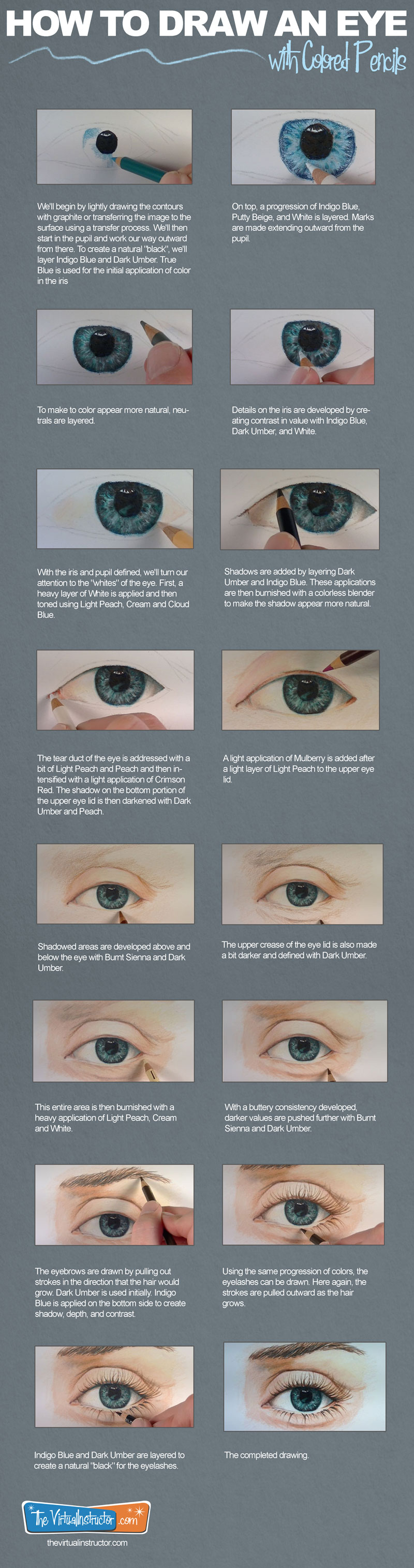
We'll brainstorm by lightly cartoon the contours with graphite or transferring the image to the surface using a transfer procedure. We'll then offset in the pupil and work our way outward from at that place. To create a natural "blackness", nosotros'll layer Indigo Blue and Night Umber. True Blue is used for the initial application of color in the iris. On top, a progression of Indigo Bluish, Putty Beige, and White is layered. Marks are made extending outward from the pupil.
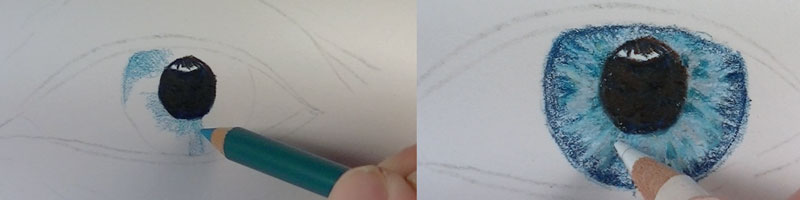
To brand to colour appear more natural, neutrals are layered. Details on the iris are developed past creating dissimilarity in value with Indigo Bluish, Night Umber, and White.
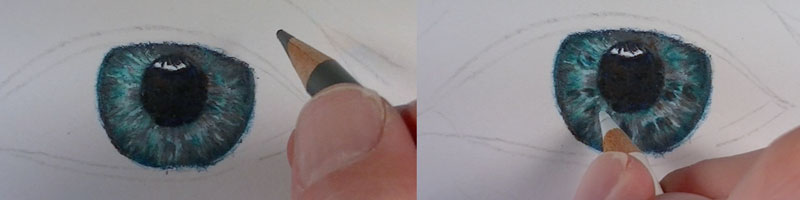
With the iris and pupil defined, we'll plow our attention to the "whites" of the eye. First, a heavy layer of White is applied and and then toned using Light Peach, Cream and Cloud Blue. Shadows are added by layering Dark Umber and Indigo Blue. These applications are then burnished with a colorless blender to make the shadow appear more than natural.
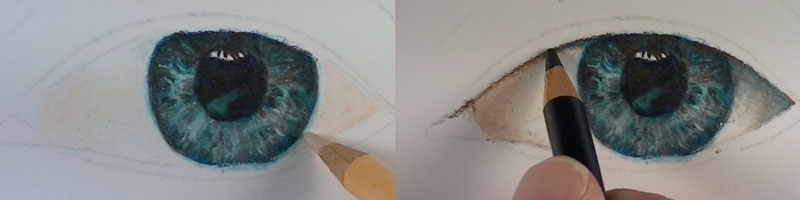
The tear duct of the eye is addressed with a bit of Light Peach and Peach so intensified with a low-cal application of Crimson Red. The shadow on the bottom portion of the upper center lid is then darkened with Nighttime Umber and Peach. A lite awarding of Mulberry is added later on a light layer of Light Peach to the upper eye lid.
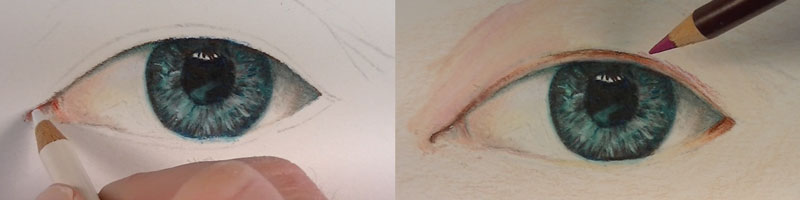
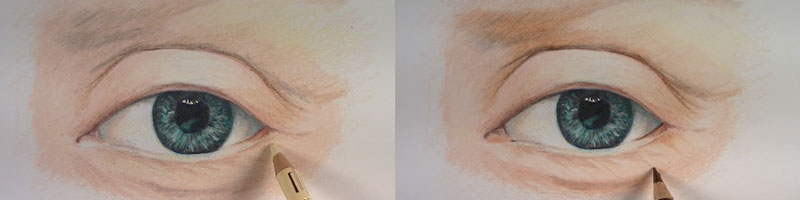
Shadowed areas are developed above and below the eye with Burnt Sienna and Dark Umber. The upper pucker of the centre chapeau is also fabricated a bit darker and defined with Dark Umber.
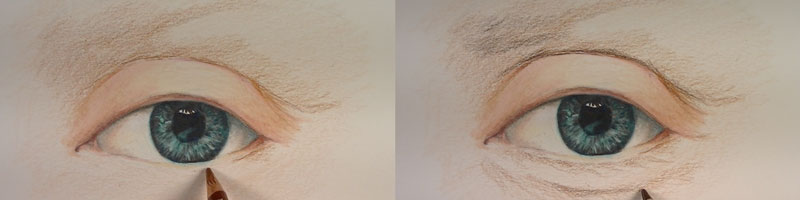
This entire area is so burnished with a heavy application of Light Peach, Cream and White. With a buttery consistency developed, darker values are pushed further with Burnt Sienna and Nighttime Umber.
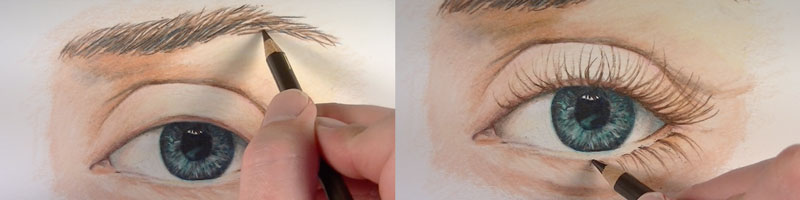
The eyebrows are drawn by pulling out strokes in the direction that the pilus would grow. Dark Umber is used initially. Indigo Blue is applied on the bottom side to create shadow, depth, and contrast. Using the same progression of colors, the eyelashes tin be drawn. Here again, the strokes are pulled outward equally the hair grows.
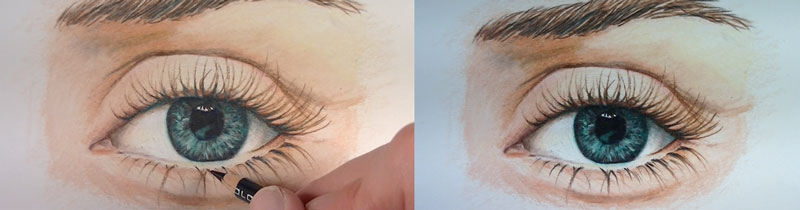
Indigo Blue and Nighttime Umber are layered to create a natural "black" for the eyelashes, completing the drawing.
Want this footstep by pace as a handy infographic? Simply click on the epitome beneath to enlarge...
More than Lessons You lot'll Love...

Source: https://thevirtualinstructor.com/how-to-draw-realistic-eye-colored-pencils.html
Posted by: roseselven54.blogspot.com
0 Response to "How To Draw A Stylized Eyes"
Post a Comment