

How To Draw Electric Field Vectors
Electric Field Lines
A more useful means of visually representing the vector nature of an electric field is through the use of electric field lines of force. Rather than depict countless vector arrows in the space surrounding a source charge, it is perhaps more useful to draw a pattern of several lines that extend between infinity and the source charge. These blueprint of lines, sometimes referred to equally electric field lines , indicate in the direction that a positive examination accuse would advance if placed upon the line. As such, the lines are directed away from positively charged source charges and toward negatively charged source charges. To communicate information about the direction of the field, each line must include an arrowhead that points in the appropriate direction. An electric field line blueprint could include an infinite number of lines. Because cartoon such large quantities of lines tends to decrease the readability of the patterns, the number of lines is usually limited. The presence of a few lines around a charge is typically sufficient to convey the nature of the electric field in the space surrounding the lines. There are a diversity of conventions and rules to drawing such patterns of electric field lines. The conventions are merely established in order that electric field line patterns communicate the greatest amount of data nearly the nature of the electric field surrounding a charged object. I common convention is to surroundings more than charged objects by more lines. Objects with greater accuse create stronger electric fields. Past surrounding a highly charged object with more lines, one can communicate the strength of an electric field in the space surrounding a charged object by the line density. This convention is depicted in the diagram below. Not only does the density of lines surrounding whatever given object reveal information nigh the quantity of charge on the source accuse, the density of lines at a specific location in space reveals information A second rule for drawing electric field lines involves drawing the lines of forcefulness perpendicular to the surfaces of objects at the locations where the lines connect to object's surfaces. At the surface of both symmetrically shaped and irregularly shaped objects, in that location is never a component of electric strength that is directed parallel to the surface. The electrical force, and thus the electric field, is ever directed perpendicular to the surface of an object. If in that location were ever whatsoever component of force parallel to the surface, then whatever backlog charge residing upon the surface of a source charge would begin to accelerate. This would pb to the occurrence of an electric current within the object; this is never observed in static electricity. In one case a line of force leaves the surface of an object, it will often alter its direction. This occurs when drawing electric field lines for configurations of two or more charges as discussed in the department below. A final rule for drawing electric field lines involves the intersection of lines. Electrical field lines should never cross. This is particularly of import (and tempting to suspension) when drawing electric field lines for situations involving a configuration of charges (every bit in the section below). If electric field lines were ever immune to cantankerous each other at a given location, and then you might be able to imagine the results. Electrical field lines reveal information well-nigh the direction (and the strength) of an electric field within a region of infinite. If the lines cross each other at a given location, then there must be two distinctly different values of electric field with their own individual direction at that given location. This could never be the case. Every single location in space has its ain electric field strength and management associated with it. Consequently, the lines representing the field cannot cross each other at any given location in space. In the examples above, we've seen electric field lines for the space surrounding unmarried point charges. Only what if a region of infinite contains more than 1 point accuse? How can the electrical field in the infinite surrounding a configuration of two or more than charges exist described past electric field lines? To answer this question, we will start return to our original method of cartoon electrical field vectors. Suppose that there are ii positive charges - charge A (QA) and charge B (QB) - in a given region of space. Each charge creates its own electrical field. At any given location surrounding the charges, the strength of the electric field tin be calculated using the expression kQ/d2. Since there are two charges, the kQ/d2 adding would have to be performed twice at each location - once with kQA/dA two and once with kQB/dB 2 (dA is the distance from that location to the heart of charge A and dB is the distance from that location to the center of charge B). The results of these calculations are illustrated in the diagram below with electrical field vectors (EastA and EastB) drawn at a variety of locations. The strength of the field is represented by the length of the arrow and the direction of the field is represented past the direction of the pointer. Since electric field is a vector, the usual operations that employ to vectors can be applied to electric field. That is, they can exist added in head-to-tail fashion to make up one's mind the resultant or net electric field vector at each location. This is shown in the diagram beneath. The diagram above shows that the magnitude and direction of the electric field at each location is simply the vector sum of the electric field vectors for each private charge. If more locations are selected and the procedure of drawing EastwardA, EB and Enet is repeated, then the electric field forcefulness and management at a multitude of locations will be known. (This is not done since it is a highly time intensive task.) Ultimately, the electric field lines surrounding the configuration of our two charges would brainstorm to emerge. For the limited number of points selected in this location, the ancestry of the electrical field line pattern tin be seen. This is depicted in the diagram below. Note that for each location, the electric field vectors indicate tangent to the direction of the electric field lines at whatever given betoken. The structure of electric field lines in this manner is a tedious and cumbersome task. The use of a field plotting calculator software program or a lab process produces like results in less fourth dimension (and with more phun). Whatsoever the method used to determine the electric field line patterns for a configuration of charges, the general idea is that the blueprint is the resultant of the patterns for the individual charges within the configuration. The electric field line patterns for other charge configurations are shown in the diagrams below. In each of the to a higher place diagrams, the individual source charges in the configuration possess the same corporeality of charge. Having an identical quantity of charge, each source charge has an equal ability to change the space surrounding it. Subsequently, the pattern is symmetrical in nature and the number of lines emanating from a source charge or extending towards a source accuse is the same. This reinforces a principle discussed before that stated that the density of lines surrounding any given source charge is proportional to the quantity of charge on that source charge. If the quantity of accuse on a source charge is not identical, the pattern will take on an asymmetric nature, every bit i of the source charges volition have a greater power to alter the electrical nature of the surrounding space. This is depicted in the electrical field line patterns below. After plotting the electric field line patterns for a diverseness of charge configurations, the general patterns for other configurations tin can exist predicted. There are a number of principles that will assistance in such predictions. These principles are described (or re-described) in the list below. It has been emphasized in Lesson four that the concept of an electric field arose as scientists attempted to explain the activity-at-a-distance that occurs betwixt charged objects. The concept of the electrical field was first introduced by 19th century physicist Michael Faraday. It was Faraday's perception that the blueprint of lines characterizing the electric field represents an invisible reality. Rather than thinking in terms of i charge affecting another charge, Faraday used the concept of a field to propose that a charged object (or a massive object in the instance of a gravitational field) affects the space that surrounds information technology. As another object enters that space, it becomes affected past the field established in that space. Viewed in this mode, a charge is seen to interact with an electric field as opposed to with another accuse. To Faraday, the cloak-and-dagger to understanding activity-at-a-distance is to understand the power of charge-field-charge. A charged object sends its electrical field into space, reaching from the "puller to the pullee." Each charge or configuration of charges creates an intricate spider web of influence in the infinite surrounding it. While the lines are invisible, the effect is e'er and then real. And so as you practice the exercise of constructing electric field lines around charges or configuration of charges, you are doing more just drawing curvy lines. Rather, you are describing the electrified spider web of space that will draw and repel other charges that enter information technology. Use your understanding to answer the post-obit questions. When finished, click the push button to view the answers. one. Several electrical field line patterns are shown in the diagrams below. Which of these patterns are incorrect? _________ Explain what is wrong with all incorrect diagrams. 2. Erin Adverse drew the following electrical field lines for a configuration of two charges. What did Erin do wrong? Explain. 3. Consider the electric field lines shown in the diagram below. From the diagram, information technology is apparent that object A is ____ and object B is ____. a. +, + b. -, - c. +, - d. -, + eastward. insufficient info 5. Use your understanding of electric field lines to identify the charges on the objects in the following configurations. vi. Notice the electric field lines below for various configurations. Rank the objects according to which has the greatest magnitude of electric charge, starting time with the smallest charge.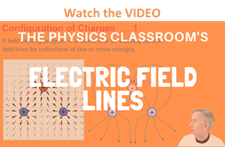 In the previous section of Lesson four, the vector nature of the electric field strength was discussed. The magnitude or strength of an electrical field in the space surrounding a source accuse is related directly to the quantity of charge on the source accuse and inversely to the distance from the source charge. The management of the electric field is always directed in the direction that a positive exam charge would be pushed or pulled if placed in the infinite surrounding the source accuse. Since electrical field is a vector quantity, information technology can be represented by a vector arrow. For any given location, the arrows point in the direction of the electric field and their length is proportional to the strength of the electrical field at that location. Such vector arrows are shown in the diagram beneath. Note that the lengths of the arrows are longer when closer to the source accuse and shorter when further from the source charge.

Rules for Drawing Electric Field Patterns


Electric Field Lines for Configurations of Ii or More Charges


Electric Field Lines every bit an Invisible Reality
We Would Like to Suggest ...
 Sometimes it isn't plenty to just read about it. You lot have to interact with it! And that'south exactly what y'all do when y'all use one of The Physics Classroom's Interactives. Nosotros would similar to suggest that you combine the reading of this folio with the apply of our Put the Charge in the Goal Interactive and/or our Electric Field Lines Interactive. Both Interactives can be institute in the Physics Interactives section of our website. Both Interactives provide engaging environments for exploring electric field lines.
 Check Your Agreement



Source: https://www.physicsclassroom.com/class/estatics/Lesson-4/Electric-Field-Lines
Posted by: roseselven54.blogspot.com
0 Response to "How To Draw Electric Field Vectors"
Post a Comment